
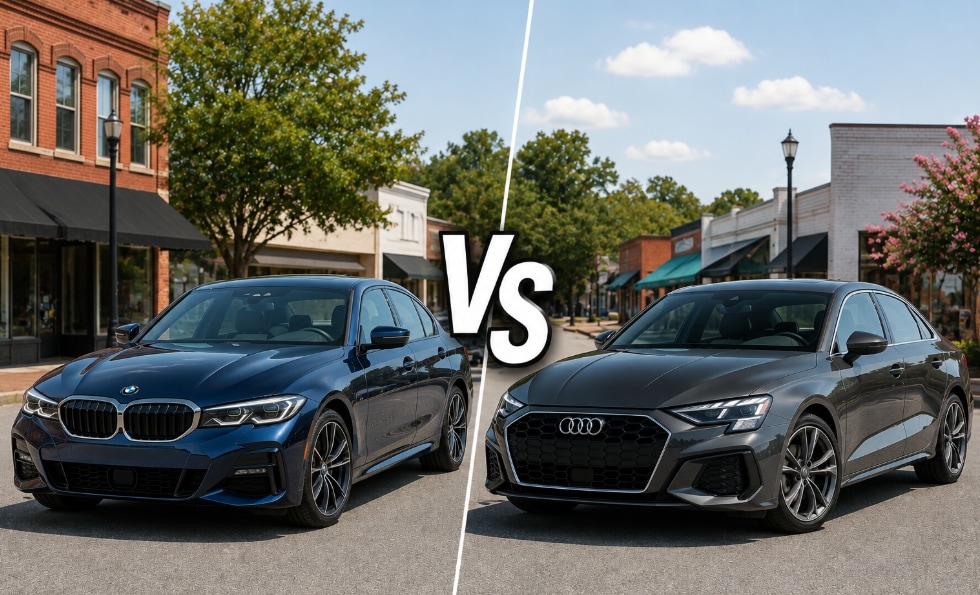
BMW vs. Audi Reliability: Which Luxury Brand Is More Reliable?
Comparing BMW and Audi Reliability, Performance, MPG and Ownership for Macon, Warner Robins and Forsyth Drivers
If you're shopping for a German luxury vehicle, there's a good chance your search eventually comes down to BMW vs. Audi. Both brands offer beautifully finished interiors, advanced technology, turbocharged engines and performance that makes an ordinary commute considerably more interesting. But there's another question that matters after the new-car excitement wears off: Is BMW or Audi more reliable?
The answer isn't as simple as declaring one badge universally better. Reliability varies by model, engine, model year and maintenance history. However, recent reliability data gives BMW shoppers some compelling reasons to take a closer look at the brand.
At BMW of Macon, we work with luxury-car shoppers from Macon, Warner Robins, Forsyth and throughout Middle Georgia. Here's what you should know if BMW vs. Audi reliability is part of your buying decision.
Is BMW More Reliable Than Audi?
Based on several recent model-level reliability ratings, BMW has an advantage over comparable Audi vehicles, although the size of that advantage depends on which models you're comparing.
For example, J.D. Power gives the 2026 BMW 3 Series an 81/100 Quality & Reliability rating, while its overall consumer rating is 82/100. The 2026 BMW 4 Series earns an even higher 84/100 Quality & Reliability rating.
Audi certainly has reliable models, too. The 2026 Audi A3, for example, receives an 80/100 Quality & Reliability score. But other models don't fare as well. The 2026 Audi A6 scores 74/100 for Quality & Reliability, while the 2026 Audi Q7 receives 66/100.
That doesn't mean every BMW will outlast every Audi. It does mean the old assumption that choosing a BMW automatically means accepting questionable reliability is increasingly outdated.
Why Has BMW Reliability Improved?
Modern BMWs have benefited from years of refinement to the company's core powertrains and vehicle architectures.
One particularly important example is BMW's turbocharged inline-six engine family. The smooth, powerful inline-six has been part of BMW's identity for decades, and current versions combine strong performance with everyday usability.
BMW also uses its turbocharged four-cylinder engines extensively throughout the lineup. Rather than developing a completely different powertrain for every model, BMW can refine core technologies across multiple vehicles.
For a buyer planning to keep a luxury vehicle beyond the initial lease or warranty period, that powertrain maturity matters. Maintenance still matters, though. Neither BMW nor Audi should be treated like an appliance that can be driven indefinitely while ignoring its recommended service schedule. Oil changes, fluids, tires, brakes and scheduled inspections become increasingly important as mileage accumulates.
BMW vs. Audi: Which Is Better to Drive?
Reliability may get you to the dealership, but driving dynamics are often what sell a BMW.
BMW has built its reputation around creating vehicles that feel responsive from behind the wheel. Even mainstream models such as the 3 Series and X3 are designed to balance comfort with handling, while M Performance and BMW M models take performance considerably further.
BMW vs. Audi SUVs: X3, X5 and X7 or Q5, Q7 and Q8?
The BMW-Audi rivalry becomes particularly interesting for SUV shoppers.
BMW's core lineup includes the compact X3, midsize X5 and three-row X7, along with additional models positioned around them. Audi counters with vehicles including the Q3, Q5, Q7 and Q8.
For families in Warner Robins or Forsyth, the decision may come down to something more practical than outright performance.
Think about how you'll actually use the vehicle.
A BMW X3 can be a strong choice for someone who wants luxury without driving a large SUV. The BMW X5 adds more passenger and cargo space while retaining the engaging character BMW shoppers expect. For families needing three rows, the BMW X7 moves into full-size luxury territory.
Reliability should be one part of that decision, but so should passenger space, cargo capacity, fuel economy, towing requirements and how comfortable you find the driver's seat after an hour on I-75.
BMW vs. Audi Maintenance Costs
Both BMW and Audi can cost more to maintain than a typical mainstream vehicle.
They're sophisticated European luxury vehicles with turbocharged engines, advanced electronics and specialized components. Tires, brakes and replacement parts can also cost more than those for an economy sedan or compact crossover.
That doesn't necessarily make either expensive to own relative to its segment. It means preventative maintenance matters. A well-maintained BMW with documented service history is a very different used-car proposition from one whose previous owner postponed maintenance.
That's also why shoppers considering a pre-owned BMW should look beyond mileage alone. Maintenance records, condition and previous ownership can be just as important.
Is BMW Reliable After 100,000 Miles?
A properly maintained BMW can certainly exceed 100,000 miles. The more useful question is:
What maintenance will a BMW need as it approaches and passes 100,000 miles?
Higher-mileage ownership may eventually involve suspension components, cooling-system components, seals, electronics and other wear items in addition to routine oil, brake and tire service.
The same principle applies to Audi.
If you're buying a used German luxury vehicle with substantial mileage, a pre-purchase inspection and complete service history are worth far more than assumptions about either brand.
BMW vs. Audi Technology
Both manufacturers have moved aggressively toward digital cabins, sophisticated driver-assistance systems and connected vehicle features. BMW's current models integrate the brand's iDrive interface with large digital displays and connected services. Audi similarly uses highly digital cockpit designs across much of its range.
There's an important reliability consideration here that buyers sometimes overlook: modern vehicle reliability isn't only about engines and transmissions.
J.D. Power's Quality & Reliability ratings include defects, malfunctions and design issues across the entire vehicle, including infotainment systems. That helps explain why modern reliability scores can sometimes differ from an owner's perception of whether a vehicle is mechanically dependable.
When test-driving either brand, spend time using the technology rather than focusing only on acceleration and handling. Connect your phone. Try the navigation. Adjust the climate controls. Test the driver-assistance settings.
BMW vs. Audi: Which Should You Buy?
For shoppers primarily concerned about BMW vs. Audi reliability, current data gives BMW a stronger case than its old reputation might suggest. But reliability isn't the only reason to choose one.
-
Choose a BMW if you place a premium on engaging performance, responsive handling, refined powertrains and a luxury vehicle that still feels designed around the person driving it.
-
Choose an Audi if you prefer its particular approach to interior design, technology and quattro-equipped driving dynamics.
Shop BMW Vehicles in Macon, GA
For luxury shoppers throughout Macon, Warner Robins, Forsyth and Middle Georgia, BMW of Macon offers new BMW cars and SUVs along with pre-owned luxury vehicles.
Whether you're comparing the BMW 3 Series vs. Audi A4/A5, BMW X3 vs. Audi Q5, BMW X5 vs. Audi Q7, or simply trying to determine whether BMW is a reliable luxury brand, seeing and driving the vehicle in person can answer questions that specifications can't.
Explore BMW of Macon to see current BMW inventory, schedule a test drive or learn more about BMW ownership in Middle Georgia.
Frequently Asked Questions About BMW vs. Audi Reliability
Is BMW or Audi more reliable?
Reliability varies by model and model year, but several current BMW models receive strong J.D. Power Quality & Reliability scores. For 2026, the BMW 3 Series scores 81/100 and the BMW 4 Series scores 84/100. By comparison, the 2026 Audi A3 scores 80/100, the A6 scores 74/100.
Are BMWs reliable after 100,000 miles?
BMWs can last well beyond 100,000 miles when properly maintained. At higher mileage, service history and vehicle condition become particularly important. Buyers should also budget for wear items and age-related repairs that can occur with any luxury vehicle.
Is a BMW expensive to maintain?
BMW maintenance can cost more than maintenance on a mainstream vehicle because of its sophisticated powertrains, electronics and premium components. Staying ahead of scheduled maintenance can help prevent smaller problems from becoming more expensive repairs.
Is Audi expensive to maintain?
Audi is also a German luxury brand, so owners should expect maintenance and repair expenses consistent with the premium segment. Actual costs depend heavily on the vehicle, powertrain, age and mileage.
Which is more reliable, BMW X3 or Audi Q5?
The answer can change by model year and powertrain. Shoppers should compare reliability information for the specific X3 and Q5 years they're considering rather than relying on brand reputation alone.
Does BMW get good gas mileage?
Several BMW models deliver surprisingly strong fuel economy considering their performance. J.D. Power lists the 2026 BMW 3 Series and 5 Series at 26 to 28 mpg combined, depending on configuration.
Should I buy a used BMW or used Audi?
Condition and maintenance history should play a major role in either purchase. A well-maintained vehicle with documented service history is generally preferable to choosing solely by brand or mileage.
Where can I buy a BMW near Warner Robins or Forsyth, GA?
BMW of Macon serves luxury vehicle shoppers from Macon, Warner Robins, Forsyth and surrounding Middle Georgia communities. Shoppers can compare BMW sedans and SUVs, arrange a test drive and discuss ownership and maintenance with the dealership team. Visit BMW of Macon